Asakura Mukaiyama Castle (Yabu City, Hyogo Prefecture) Complete Guide: History, Remains, and Access Explained in Detail
Asakura Mukaiyama Castle, located in Asakura, Yoka-cho, Yabu City, Hyogo Prefecture, is a mountain castle that played an important role in the Tajima region during the Sengoku period. Also known as “Kaminoyama Castle,” this castle was built on a mountaintop at an altitude of 213.4 meters and functioned as a natural stronghold surrounded by the Maruyama River and Yagi River. This article provides a detailed explanation for castle enthusiasts and history buffs, covering everything from the historical background of Asakura Mukaiyama Castle to existing remains, climbing routes, and related castles in the surrounding area.
What is Asakura Mukaiyama Castle?
Asakura Mukaiyama Castle is a medieval mountain castle located in Mukaiyama, Asakura, Yoka-cho, Yabu City, Hyogo Prefecture. Although currently located within the Yoka area, it was formerly situated in Kaminoyama, which was part of Asakura Village, hence its alternative name, “Kaminoyama Castle.”
Basic Information
- Location: Mukoyama, Asakura, Yoka-cho, Yabu City, Hyogo Prefecture
- Castle Structure: Mountain Castle
- Elevation: 213.4 meters
- Relative Height: Approximately 178 meters
- Construction Period: Sengoku period (estimated)
- Builder: Asakura clan
- Major Remains: Moats, vertical moats, baileys, earthworks
- Designation: City-designated historical site (Yabu City)
The most distinctive feature of Asakura Mukoyama Castle lies in its location. Built on a mountaintop between two rivers, the Maruyama River and the Yagi River, it offered an excellent vantage point for observation, overlooking Ebara (present-day Hidaka-cho), Yabu-ichiba (present-day Yabu-cho), and Yagitani. This geographical advantage greatly enhanced the castle’s military value.
History of Asakura Mukaiyama Castle
The Asakura Clan and Tajima Province
To understand Asakura Mukaiyama Castle, it’s necessary to first understand the history of the Tajima Asakura clan. Asakura in Tajima Province was the birthplace of the Asakura clan, who later ruled Echizen Province (present-day Fukui Prefecture) as a Sengoku daimyo (warring states period daimyo). The Asakura clan was a prestigious family descended from Prince Hyōmai, a son of Emperor Kōtoku, and had their base in Asakura, Tajima Province, since the Kamakura period.
The Echizen Asakura clan was a branch of this Tajima Asakura clan. During the Nanboku-chō period, some members of the family migrated to Echizen and eventually developed into a Sengoku daimyo. The roots of the Asakura clan, who reached the height of their power in Ichijōdani, Fukui Prefecture, lie in this Tajima region.
Background and Purpose of the Castle’s Construction
While there are few historical records regarding the exact construction date and builder of Asakura Mukaiyama Castle, it is believed to have been built or extensively renovated by the Asakura clan during the late Sengoku period.
The reason this castle was considered important lies in its strategic location. Asakura Mukaiyama Castle was situated at a key point overlooking the San’in Road, playing a role in monitoring and defending the major road connecting east and west within Tajima Province. Located east of Asakura Castle, the Asakura clan’s main residence, it is presumed to have functioned as an eastern defensive base within the Asakura territory.
Asakura Mukaiyama Castle in the Sengoku Period
During the late Sengoku period, Asakura Mukaiyama Castle underwent renovations along with Asakura Castle. These renovations strengthened defensive structures such as moats and trenches, transforming it into a more practical fortress. Evidence of the addition of Sengoku-era technology to the basic structure built during the Muromachi period can still be seen in the remains today.
The Tajima Campaign and the Castle’s Demise during the Tensho Era
In October 1577 (Tensho 5), the “Tajima Campaign,” led by Hashiba Hidenaga (Toyotomi Hideyoshi’s younger brother) under the orders of Oda Nobunaga, was launched. During this military operation, Asakura Oi, the lord of Asakura Castle, surrendered along with Yagi Toyonobu, the lord of Yagi Castle.
While there are no specific battle records of Asakura Mukaiyama Castle during this Tajima Campaign, it is believed that it lost its function as a defensive base following the surrender of the Asakura clan. The exact time of its abandonment is unclear, but it is presumed that, like many medieval mountain castles, it ceased to serve its military role during the Oda regime’s rule of Tajima.
Structure and Remains of Asakura Mukaiyama Castle
Characteristics of the Castle’s Layout
Asakura Mukaiyama Castle is a typical mountain castle built around the summit of a mountain 213.4 meters above sea level. The castle’s layout, taking advantage of its steep terrain with a relative elevation of approximately 178 meters, was a significant obstacle for attackers.
While detailed survey data regarding the castle’s size is limited, it is believed to have consisted of multiple baileys (enclosures) centered around the main enclosure. From the main enclosure at the mountaintop, as mentioned earlier, one could overlook Ehara, Yabu-Ichiba, and Yagitani, making it a structure that combined both surveillance and military base functions.
Moats
One of the most prominent remains of Asakura Mukaiyama Castle is the moat. A moat is a dry moat dug to cut across a ridge, serving to prevent enemy intrusion and clearly demarcate the castle grounds.
Multiple moats have been identified at Asakura Mukaiyama Castle, and these are thought to have been reinforced during renovations in the late Sengoku period. The depth and width of the moats vary depending on the location, but they clearly divide the ridge, making them valuable remains that convey the defensive thinking of the time.
Vertical Moats
Vertical moats are moats dug vertically along slopes, effectively hindering enemy lateral movement and limiting attack routes. At Asakura Mukaiyama Castle, vertical moats were strategically placed along the main ridges and slopes, creating a three-dimensional defensive network in combination with trenches.
Vertical moats are a testament to the development of castle construction technology during the Sengoku period, indicating that Asakura Mukaiyama Castle was not merely a surveillance post but a defensive facility designed with actual combat in mind.
Enclosures (Kuruwa)
It is presumed that the main enclosure was located at the mountaintop, surrounded by multiple enclosures arranged in a stepped fashion. Each enclosure was leveled and likely used for troop garrisons and supply storage.
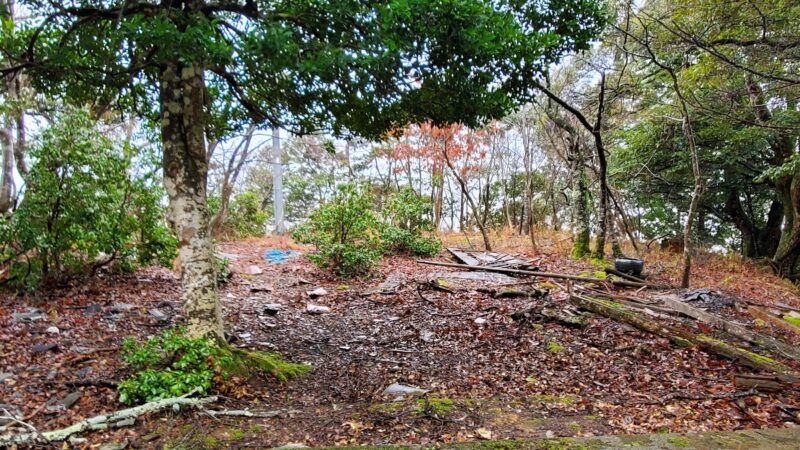
While much of the scale and arrangement of the enclosures is inferred from on-site topographical observations, they retain the basic structure of a mountain castle. The view from the main enclosure is magnificent, giving a strong sense of its important role in monitoring the surrounding area during the Sengoku period.
Earthworks
Traces of earthworks have been confirmed in some of the enclosures. Earthworks were built by constructing mounds of earth around enclosures to serve as defensive walls, protecting soldiers from arrows and stones. While some parts of the earthworks at Asakura Mukaiyama Castle are difficult to discern due to weathering and vegetation, they are important remains for understanding the castle’s defensive structure.
Highlights of Asakura Mukaiyama Castle
Observing Defensive Remains
The greatest attraction of visiting Asakura Mukaiyama Castle is the opportunity to see firsthand the defensive techniques of the Sengoku period. In particular, the moats and vertical trenches are relatively well-preserved, allowing visitors to appreciate the high level of castle-building technology of the time.
When observing the moats, pay attention to their depth, width, and the thorough construction that completely cuts off the ridge. Also, by observing how the vertical trenches run along the slopes and how multiple vertical trenches are arranged, you can gain insight into the overall defensive plan of the castle.
Experiencing the View and Location
The view from the mountaintop is another highlight of Asakura Mukaiyama Castle. The panoramic view overlooking Ebara, Yabu Market, and Yagitani demonstrates the castle’s excellent location as a surveillance post.
On a clear day, you can even see the flow of the Maruyama River and Yagi River, understanding how the rivers functioned as natural moats. Imagining the castle lords and soldiers of the Sengoku period gazing upon the same scenery from this spot while on guard patrol evokes a sense of historical romance.
Positional Relationship with the San’in Road
Asakura Mukaiyama Castle overlooks the San’in Road. When visiting the site, it’s fascinating to consider the route the road took and how it could be monitored from the castle. This highlights the crucial role of controlling a vital transportation hub in medieval castles.
Access to Asakura Mukaiyama Castle
Using Public Transportation
- Nearest Station: JR San’in Main Line “Yoka Station”
- Distance from Station: Approximately 3 kilometers
- Travel Time: Approximately 40 minutes on foot, approximately 10 minutes by taxi
While it is possible to access the castle on foot from Yoka Station, the distance to the trailhead is considerable, so those who are not confident in their physical fitness are advised to take a taxi. There is a taxi stand in front of the station.
Using a Car
- Approximately 10 minutes from Kita-Kinki Toyooka Expressway “Yoka-Hyono-yama IC”
- Accessible from National Route 9
- Parking: There is no dedicated parking lot, so please use the roadside space around the Asakura settlement (consideration is required to avoid causing inconvenience).
Ascent Route
The most common route to Asakura Mukaiyama Castle is to climb the mountain path from the Asakura settlement. The elevation difference is approximately 178 meters, and the climb to the castle takes about 1 to 1.5 hours.
Points to note when climbing:
- Many parts of the trail are not well maintained, so non-slip shoes such as hiking boots or athletic shoes are essential.
- In summer, the vegetation is dense, so wearing long sleeves and long pants is recommended.
- Carry drinking water, a map, a compass, and a mobile phone.
- Avoid climbing alone; visiting with multiple people is preferable.
- Avoid climbing in bad weather or during winter, as it is dangerous.
- Be careful not to damage the ruins.
Related Castles in the Surrounding Area
When visiting Asakura Mukaiyama Castle, visiting the related castles in the surrounding area will give you a deeper understanding of the sphere of influence and defensive system of the Tajima Asakura clan.
Asakura Castle
This is the residence of the Asakura clan, located approximately 1.6 kilometers from Asakura Mukaiyama Castle. Located on a hill 152 meters above sea level, this is a full-fledged mountain castle measuring 180 meters north-south and 95 meters east-west. It has been preserved as the birthplace of the Echizen Asakura clan, and its remains are well-preserved.
Asakura Castle is demarcated at its southern end by three moats, clearly showing traces of renovations made to the Muromachi period castle during the Sengoku period. Visiting it together with Asakura Mukaiyama Castle allows you to experience the relationship between the main castle and its subsidiary castles.
Asakura Bikuni Castle
This castle is located approximately 0.5 kilometers from Asakura Castle. As part of a group of castles associated with the Asakura clan, it formed a defensive network. Although many details remain unknown, it is an important historical site indicating the Asakura clan’s sphere of influence.
Yagi Castle
This was the residence of the Yagi clan, who held power in Tajima at the same time as the Asakura clan. During the Tajima campaign of the Tensho era, it was the base of Yagi Toyonobu, who surrendered along with the Asakura clan. This castle is important for understanding the Sengoku period history of Tajima.
Shingu Castle
This castle is located approximately 1.1 kilometers from Asakura Mukaiyama Castle. It was part of the castle network in the Tajima region.
Historical Significance of Asakura Mukaiyama Castle
Defense Strategy of the Tajima Asakura Clan
Asakura Mukaiyama Castle held a crucial position in the defense strategy of the Tajima Asakura clan. Located east of their main castle, Asakura Castle, its role in monitoring the San’in-do, a major highway, was essential for the defense of their territory.
The fact that it was renovated along with Asakura Castle in the late Sengoku period shows that the Asakura clan valued this castle. It played a part in a “castle network” that coordinated multiple castles to defend their territory.
Connection to the Echizen Asakura Clan
The group of castles belonging to the Tajima Asakura clan, including Asakura Mukaiyama Castle, are also important historical sites that indicate the roots of the Echizen Asakura clan. The fact that the ancestors of the Asakura clan, who prospered in Ichijōdani, established their power base in this Tajima region is a valuable example illustrating the migration and development of clans in Japanese history.
By connecting the Asakura clan ruins in Fukui Prefecture with the Asakura clan castles in Tajima, a clearer overall picture of the Sengoku period daimyo Asakura clan emerges.
Value in Mountain Castle Research
Asakura Mukaiyama Castle is a valuable site for the study of Sengoku period mountain castles. Defensive structures such as moats and vertical trenches are relatively well-preserved, providing important materials for studying the castle construction techniques and defensive philosophies of the time.
Furthermore, its value as educational material for learning about diverse aspects of medieval castles, such as the relationship between the main castle and its subsidiary castles, and the characteristics of castles with road monitoring functions, is highly regarded.
Points to Note When Visiting Asakura Mukaiyama Castle
Preparations
Before visiting Asakura Mukaiyama Castle, we recommend the following preparations:
- Obtain a Topographic Map: Check the route in advance using a topographic map from the Geospatial Information Authority of Japan or a hiking app.
- Check the Weather: Visiting a mountain castle is heavily dependent on the weather, so choose a sunny day.
- Check Your Physical Fitness: This is a climb with an elevation difference of 178 meters, so consider your own physical fitness.
- Prepare Equipment: Hiking boots, drinking water, hat, towel, insect repellent, first-aid kit, etc.
Best Time to Visit
- Spring (April-May): Beautiful fresh greenery, and temperatures suitable for hiking.
- Autumn (October-November): Enjoy the autumn foliage, and there are fewer insects, making it a comfortable experience.
- Summer: Lush vegetation reduces visibility, and caution is needed regarding heat and insects.
- Winter: There is a possibility of snow and ice; should be avoided unless you are an experienced hiker.
Estimated Time Required
- Ascent to the Castle: 1 hour to 1 hour 30 minutes
- Exploring the Castle Grounds: 30 minutes to 1 hour
- Descent: 45 minutes to 1 hour
- Total: Approximately 3 to 4 hours
Please plan your itinerary with ample time to descend before sunset.
Asakura Mukaiyama Castle and the History and Culture of Tajima
Asakura Mukaiyama Castle is important not only as a standalone castle but also for understanding the history and culture of the Tajima region.
The Sengoku Period in Tajima
During the Sengoku period, Tajima Province was a region where many local lords vied for power. The Asakura, Yagi, and Otagaki clans, among others, each had their own spheres of influence, and complex alliances and conflicts constantly arose.
Asakura Mukaiyama Castle symbolized the power of the Asakura clan within this political situation of Sengoku Tajima. Controlling the San’indo, a crucial transportation hub, held significant economic and military importance. ### The Oda Regime and Tajima
The 1577 invasion of Tajima was part of Oda Nobunaga’s expansion into the Chugoku region. The Oda army, led by Hashiba Hidenaga, invaded, and the local lords of Tajima surrendered one after another, incorporating them into the Oda regime.
The surrender of the Asakura clan symbolized the end of medieval regional power in Tajima. Asakura Mukaiyama Castle also holds significant meaning as a fortress that witnessed this turning point in history.
Current Status of Preservation and Utilization
Asakura Mukaiyama Castle is a designated historical site of Yabu City, but no full-scale maintenance has been carried out, and it is basically preserved in its natural state.
Preservation Status
While the remains are relatively well-preserved, some parts are covered by overgrown vegetation. Because regular mowing and maintenance are not carried out, visitors can enjoy the pleasure of searching for the remains buried in nature, but some parts are difficult to identify.
Future Challenges
The castle complex of the Tajima Asakura clan, including Asakura Mukaiyama Castle, is expected to benefit from more active preservation and utilization, especially from the perspective of its connection to the Echizen Asakura clan. Collaboration with the Ichijodani Asakura Clan Ruins in Fukui Prefecture and the development of a wider-area historical tourism route are also potential future possibilities.
Summary
Asakura Mukaiyama Castle, a Sengoku period mountain castle remaining in Yabu City, Hyogo Prefecture, is a castle of high historical and structural value. Functioning as an eastern defense base for the Tajima Asakura clan and strategically located to monitor the San’in Road, this castle conveys the nature of regional power during the Sengoku period.
The remains, such as moats, vertical trenches, baileys, and earthworks, are valuable historical materials that convey the castle-building techniques and defensive philosophies of the time, making it an unmissable site for castle enthusiasts. Furthermore, in the context of being the birthplace of the Echizen Asakura clan, it is an important historical site that demonstrates the movement and development of clans throughout Japanese history.
Climbing to the castle requires considerable preparation and physical stamina, but the view from the summit and the remains that evoke the spirit of the Sengoku period will more than reward your efforts. This is a castle that anyone interested in the history of Tajima or who enjoys exploring mountain castles should definitely visit.
By visiting Asakura Mukaiyama Castle, you can experience firsthand the local history, the lives of the people, and the tension of the Sengoku period—things you won’t find in textbooks. Standing on the stage of history and gazing upon the same scenery as the people of that time is an experience of priceless value.