Gochaku Castle (Himeji City, Hyogo Prefecture) Complete Guide: History and Highlights of the Three Great Castles of Harima, Associated with Kuroda Kanbei
What is Gochaku Castle?
Gochaku Castle was a flatland castle located in Gochaku, Mikunino-cho, Himeji City, Hyogo Prefecture, and is an important castle representing Harima Province. Along with Miki Castle of the Bessho clan and Aga Castle of the Miki clan, it is counted as one of the Three Great Castles of Harima, and played a central role in politics and military affairs in the Harima region during the Sengoku period.
The castle was built on a slightly elevated area called Chausuyama, approximately 13-14 meters above sea level, hence its alternative name Chausuyama Castle. It is also known as Tenkawa Castle because the Tenkawa River was used as part of its moat. Currently, it is maintained as Gochaku Castle Ruins Park and is a place visited by many history enthusiasts as a site associated with Kuroda Kanbei.
History of Gochaku Castle
Construction and the Kodera Clan’s Rule
Gochaku Castle was built in Eisho 16 (1519) by Kodera Masataka, a vassal of the Akamatsu clan, the shugo (military governor) of Harima Province. Gochaku, in Mikunino-cho, east of Himeji City, was a strategically important location on the Sanyo Road (slightly south of the current National Route 2), and had long been a key site for the Akamatsu clan’s shugo residence.
The Kodera clan, as a branch of the Akamatsu clan, expanded their power within Harima Province, using Gochaku Castle as their base and controlling the surrounding area. After Masataka, the lineage continued with Noriyoshi and then Masayoshi, and the Kodera clan grew into a powerful Sengoku daimyo (feudal lord) with significant influence within Harima Province.
Kuroda Kanbei and Gochaku Castle
Indispensable to understanding the history of Gochaku Castle is the presence of Kuroda Kanbei (then known as Kodera Takataka), who later served as a military strategist for Toyotomi Hideyoshi. The Kuroda clan served as vassals of the Kodera clan, and Kanbei served as a chief retainer at Gochaku Castle.
The graves of Kanbei’s grandfather, Kuroda Shigetaka, and his mother (of the Akashi clan) still remain on the west side of the Gochaku Castle ruins, with two five-tiered pagodas standing side by side. This Kuroda family cemetery is an important historical site that conveys the deep connection between Kanbei and Gochaku Castle.
Kanbei operated from Gochaku Castle and would later play a crucial role in Oda Nobunaga’s conquest of the Chugoku region. It is believed that his diplomatic skills and military strategies were based on his experiences at Gochaku Castle.
Hashiba Hideyoshi’s Invasion of Harima and the Fall of the Castle
In 1577 (Tensho 5), Hashiba Hideyoshi (later Toyotomi Hideyoshi), acting on orders from Oda Nobunaga, invaded Harima. Initially, Kodera Masamoto showed a willingness to cooperate with Hideyoshi, but the situation within Harima Province was complex, and his relationship with the Mori clan was also intertwined.
Kuroda Kanbei advocated for allegiance to the Oda clan, but Kodera Masamoto reversed his stance and decided to side with the Mori. This decision sealed the fate of Gochaku Castle. Between 1578 and 1579, Gochaku Castle was attacked during Hideyoshi’s invasion of Harima, leading to the downfall of the Kodera clan and the abandonment of the castle.
During this period, Kanbei experienced hardship, including imprisonment at Arioka Castle (Itami Castle), but he would later play an active role under Hideyoshi. The fall of Gochaku Castle symbolized the end of the Sengoku period in Harima and the beginning of a new era.
Structure and Layout of Gochaku Castle
Castle Location and Topography
Gochaku Castle is located on a slightly elevated area that slopes gently from west to east, with the Tenkawa River flowing along its western and southern sides. This river functioned as a natural moat, a crucial element of the castle’s defensive system. Despite being a flatland castle, its layout cleverly utilizes the terrain.
The castle’s elevation is only about 13-14 meters, not particularly high, but its location overlooks the surrounding plains, giving it a strategic position controlling a key transportation hub. The nearby Sanyo Road indicates its importance not only militarily but also economically.
Castle History Revealed by Archaeological Excavations
Archaeological excavations conducted from 1977 to 1979 revealed the detailed history of Gochaku Castle. The results showed that Gochaku Castle existed for approximately 200 years, from the late 14th century to the late 16th century.
A particularly important discovery is the construction of large and medium-sized moats and earthworks in the mid-16th century, indicating the establishment of a full-fledged castle layout. This period coincides with the peak of the Kodera clan’s power, and is considered to be the time when the castle achieved its imposing presence as one of the three major castles of Harima Province.
Excavations have confirmed the remains of moats, traces of earthworks, and building foundations, proving that the castle fully possessed the functionality of a Sengoku period castle. The unearthed pottery also suggests the high economic power and cultural level of the Kodera clan, the castle’s lords.
Layout of the Main Enclosure and Baileys
The main enclosure (honmaru), the central part of Gochaku Castle, was located at the highest point of Chausuyama Hill. The center of the current Gochaku Castle Ruins Park corresponds to the site of the main enclosure. It is believed that multiple baileys (kuruwa) were arranged around the main enclosure, each demarcated by moats and earthworks.
While there are various theories regarding the exact boundaries of the castle grounds, it is certain that the castle covered a considerably large area, utilizing the Tenkawa River as an outer moat. It boasted a scale befitting its reputation as one of the three great castles of Harima.
Highlights of Gochaku Castle
Gochaku Castle Ruins Park
Currently, the site of Gochaku Castle’s main keep has been developed into Gochaku Castle Ruins Park, serving as a place of relaxation for citizens. Information boards detailing the castle’s history are installed within the park, allowing visitors to imagine the castle’s former appearance.
At the center of the park stands the Mikuni-no Community Center, modeled after a castle keep, serving as a symbolic landmark of Gochaku Castle. While it’s uncertain whether Gochaku Castle actually had a keep, this building visually indicates that it is a castle site.
The park is well-maintained and provides a pleasant environment for strolling. During cherry blossom season, it is bustling with visitors, and it is a popular spot for historical exploration and enjoying nature.
Kuroda Family Cemetery
To the west of Gochaku Castle Ruins Park lies the Kuroda Family Cemetery. Here stand two five-tiered stupas: one for Kuroda Shigetaka, the grandfather of Kuroda Kanbei, and the other for Akashi, Kanbei’s birth mother.
This burial site is a valuable historical site demonstrating the Kuroda clan’s deep involvement with Gochaku Castle as vassals of the Kodera clan. It’s a must-see spot for Kanbei fans and anyone interested in the history of the Kuroda family. The burial site is enveloped in a tranquil atmosphere, a place where one can reflect on the warlords of the Sengoku period.
Stone Monument and Information Boards
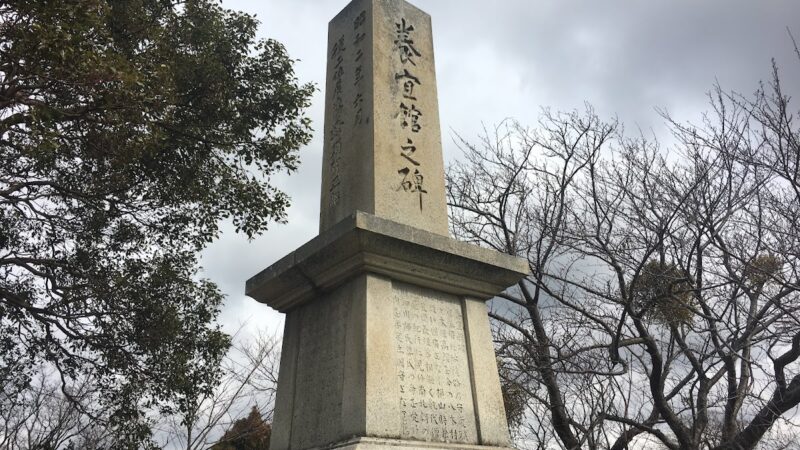
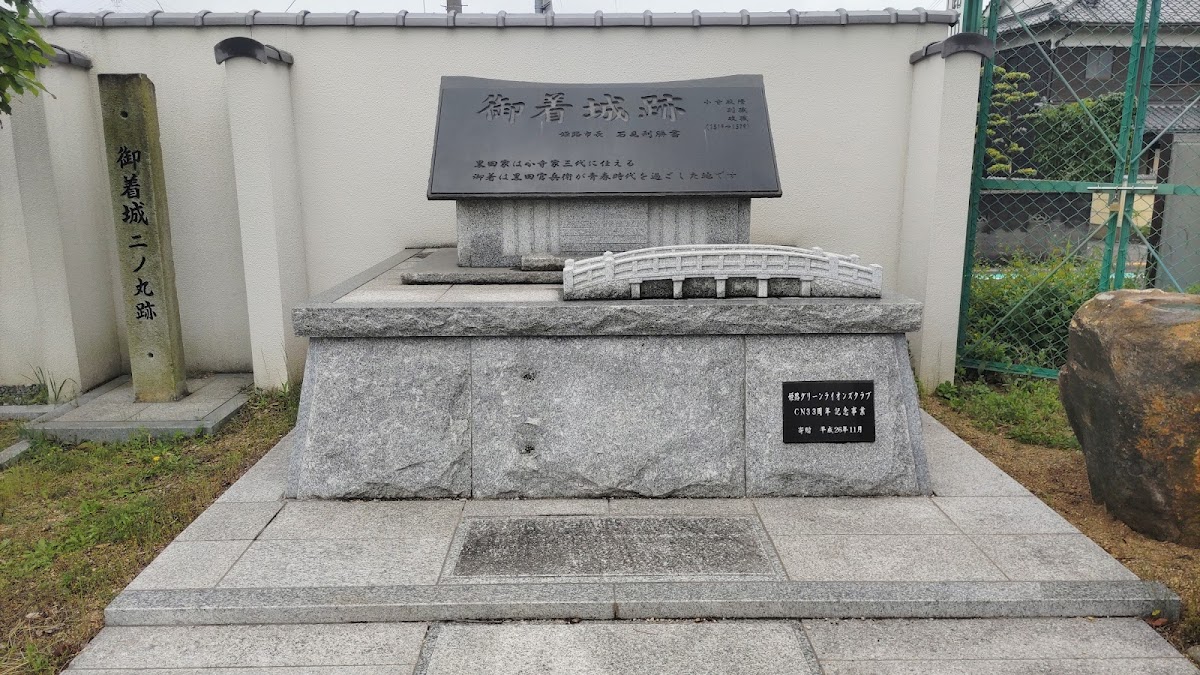
Within the castle ruins stands a stone monument marking “Gochaku Castle Ruins,” a popular spot for commemorative photos. Several information boards explaining the castle’s history and structure are also installed, making it easy for first-time visitors to understand the history of Gochaku Castle.
The information boards provide detailed explanations of the castle’s layout, historical timeline, and the relationship between the Kodera clan and Kuroda Kanbei, serving as an excellent guide for exploring the castle ruins.
Traces of Earthworks and Moats
Within the park and surrounding area, there are places where traces of earthworks and moats can be seen, albeit faintly. While not completely intact, the topography, including undulations and depressions, allows us to infer the structure of the former castle.
Especially from the west to the south of the castle ruins, the topography suggests that the course of the Tenkawa River functioned as a defensive line for the castle. Those familiar with history will enjoy imagining the appearance of the castle during the Sengoku period while walking around the site.
Access and Visiting Guide
Access by Train
The Gochaku Castle Ruins are easily accessible by public transport. The nearest station is Gochaku Station on the JR Sanyo Main Line, and the castle ruins are very close, about a 7-minute walk (approximately 600 meters) from the station.
Gochaku Station is about 5 minutes from Himeji Station on the Sanyo Main Line, two stops by local train, making it ideal for a visit in conjunction with Himeji sightseeing. There are signs guiding you from the station to the castle ruins, so you won’t get lost. Other nearby stations include Himeji-Bessho Station (approx. 1.8km) and Higashi-Himeji Station (approx. 2.7km), but access from Gochaku Station is the most convenient.
Access by Car
If visiting by car, use National Route 2 or the Sanyo Expressway. On the Sanyo Expressway, the nearest interchanges are Himeji-Higashi IC or Kakogawa-Kita IC, from which it’s about 15-20 minutes via local roads.
Gochaku Castle Ruins Park has a dedicated parking lot, which is free to use. However, parking space is limited, so it may be crowded during events.
Notes for Visitors
Gochaku Castle Ruins Park is always open, and admission is free. However, there are opening hours and closing days for tours of the Mikunino Community Center, so it is recommended to check in advance.
The castle ruins are maintained as a park, so no special equipment is required, but if you want to enjoy a historical walk, it is recommended to wear comfortable walking shoes. Furthermore, setting aside time to carefully read the information boards will allow you to gain a deeper understanding of the history of Gochaku Castle.
Nearby Tourist Attractions
Himeji Castle
Located approximately 5km west of Gochaku Castle is the World Heritage Site, Himeji Castle. After Gochaku Castle was abandoned, the center of Harima shifted to Himeji Castle. After Hashiba Hideyoshi pacified Harima, Himeji Castle underwent a major renovation, and later, Ikeda Terumasa built the magnificent keep we see today.
Visiting both Gochaku Castle and Himeji Castle allows you to experience the evolution of castles and the flow of history in Harima.
Shoshazan Engyo-ji Temple
Located in the northern part of Himeji City, Shoshazan Engyo-ji Temple is an ancient Tendai sect temple, also known as the “Hieizan of the West.” It is said that Kuroda Kanbei also visited the temple, and it is famous as a filming location for movies and dramas.
Tatsuno Castle
Located approximately 20km northwest of Gochaku Castle, Tatsuno Castle is another important castle in Harima Province. It is associated with the Akamatsu clan, and visiting both Gochaku Castle and Tatsuno Castle provides insight into the Akamatsu clan’s sphere of influence in Harima.
Gochaku Castle and the History of Harima
Positioning as one of the Three Great Castles of Harima
Gochaku Castle, along with Miki Castle (Bessho clan) and Aga Castle (Miki clan), was considered one of the three great castles of Harima. These three castles each functioned as bases controlling important regions within Harima.
Miki Castle was the residence of the Bessho clan in central Harima and is known as the site of the Battle of Miki. Aga Castle was the castle of the Miki clan, who controlled a port town in southwestern Harima. Comparing Gochaku Castle to these castles clarifies its strategic importance.
The Akamatsu Clan and the Harima Regime
The Kodera clan, who built Gochaku Castle, were a branch of the Akamatsu clan, the shugo (military governor) of Harima. The Akamatsu clan wielded considerable power as the governors of Harima, Bizen, and Mimasaka provinces from the Muromachi period onward. However, they declined during the Sengoku period, and their retainers became independent, forming their own daimyo (feudal lords).
The Kodera clan was one such example, establishing their own power base at Gochaku Castle. As the Akamatsu clan’s rule crumbled, Harima became a region divided among various clans, including the Kodera, Bessho, and Miki clans, eventually becoming a target of Oda Nobunaga’s campaign against the Chugoku region.
The Activities of Kuroda Kanbei and Gochaku Castle
Kuroda Kanbei’s experience as a chief retainer at Gochaku Castle formed the foundation for his later success. While a retainer of the Kodera clan, Kanbei accurately analyzed the situation in Harima and advocated for allegiance to Oda Nobunaga.
Even after his lord, Kodera Masamoto, decided to side with the Mori clan, Kanbei continued to cooperate with Hideyoshi, contributing to the pacification of Harima. His experience at Gochaku Castle undoubtedly fostered his strategic vision and diplomatic skills.
Kanbei later based himself at Himeji Castle and eventually rose to the rank of daimyo, becoming the lord of Nakatsu Castle in Buzen Province. However, his origins lay at Gochaku Castle.
Current Status and Preservation Activities of Gochaku Castle
Development as a Historic Site
The Gochaku Castle ruins have been developed into a historical park by Himeji City and are open to the public. Information boards have been installed based on the results of archaeological excavations, and efforts are being made to pass on the castle’s history to future generations.
In recent years, interest in Gochaku Castle has increased following the broadcast of the historical drama “Gunshi Kanbei,” which features Kuroda Kanbei as the protagonist, leading to an increase in visitors. Locally, efforts are also being made to utilize the site as a tourist resource, given its connection to Kanbei.
Future Challenges and Prospects
Continued efforts are needed for the preservation and utilization of the Gochaku Castle ruins. It is necessary to maintain the state of preservation of the remains while devising ways to convey the history to visitors in an easily understandable manner. The site is expected to incorporate new technologies for information dissemination, such as exhibits of restored CG using digital technology and castle reconstructions using AR (augmented reality). Furthermore, it could be used as a place for interaction between local residents and history enthusiasts through regular events.
Summary
Gochaku Castle, one of the three major castles of Harima, played a crucial role in the Harima region during the Sengoku period. It flourished as the residence of the Kodera clan, and the history of Kuroda Kanbei serving as a chief retainer is a significant episode in Japanese Sengoku history.
Currently, it has been developed as Gochaku Castle Ruins Park, a historical site easily accessible to everyone. Its convenient location, just a 5-minute train ride from Himeji Station and a 7-minute walk from Gochaku Station, makes it ideal for visiting in conjunction with Himeji Castle.
At Gochaku Castle Ruins, you can reflect on the history of Harima during the Sengoku period while viewing the Kuroda family tombs and castle ruins information boards. It’s a must-see spot not only for history enthusiasts but also for Kuroda Kanbei fans. When you visit Hyogo Prefecture, be sure to stop by the ruins of Gochaku Castle.