Complete Guide to Setagaya Castle (Tokyo): A Thorough Explanation of the Kira Clan’s Castle Ruins and Existing Remains
Nestled in a quiet residential area of Setagaya Ward, Tokyo, the Setagaya Castle ruins are a historic castle that served as the residence of the Kira clan for approximately 230 years, from the Nanboku-cho period to the end of the Sengoku period. Currently, it is maintained as Setagaya Castle Ruins Park and preserved as a Tokyo Metropolitan Government-designated historical site. This article provides a thorough explanation of Setagaya Castle’s history, highlights, access methods, and surrounding attractions.
History of Setagaya Castle: The Kira Clan’s 230-Year Residence
Construction of Setagaya Castle and the Oshu Kira Clan
Setagaya Castle is believed to have been built in 1366 (Jōji 5) by Kira Haruie, the first head of the Oshu Kira clan. The Kira clan was a branch of the Ashikaga clan, which traced its lineage back to the Seiwa Genji. The granting of the Setagaya territory in Musashi Province by Ashikaga Motouji, the Kanto Kanrei (governor of the Kanto region), was the impetus for the construction of the castle.
The Kira clan, as relatives of the Ashikaga shogunate, enjoyed high status and established their base in Setagaya, building a prestigious residence known as “Kira Gosho” or “Setagaya Gosho.” This designation suggests that the Kira clan was not merely a local lord, but a noble family connected to the shogunate.
The Prosperity of the Kira Clan for Eight Generations
Setagaya Castle served as the residence of the Kira clan for eight generations, approximately 230 years. During this time, the Kira clan governed the Setagaya territory, and it flourished as the political, economic, and cultural center of the region. The castle was a flatland castle built on a tongue-shaped plateau surrounded by the Karasuyama River (now an underground culvert), and it possessed a defensive structure that skillfully utilized the natural terrain.
Medieval Setagaya was located at a strategic point on transportation routes such as the Kamakura Road and the Oyama Road, and Setagaya Castle was an important military base in the region. The Kira clan played a crucial role in maintaining the Ashikaga clan’s power in the Kanto region.
Abandonment of the Castle in 1590: The Siege of Odawara and the End of the Kira Clan
The history of Setagaya Castle came to an end in 1590. In that year, Toyotomi Hideyoshi launched the Siege of Odawara, leading to the downfall of the Later Hojo clan. Because Kira Ujitomo was related to the Hojo clan, he shared the same fate as the Hojo clan.
After the Siege of Odawara, Setagaya Castle was seized by the Toyotomi forces and subsequently abandoned. It is said that some of the castle’s stonework was used in the renovation of Edo Castle, and it is believed to have been utilized in the development of the castle town after Tokugawa Ieyasu’s arrival in Edo.
Structure and Layout of Setagaya Castle
Location as a Hilltop Castle
Setagaya Castle is a hilltop castle built on the tip of a tongue-shaped plateau formed by the Karasuyama River. The Karasuyama River surrounded the plateau on three sides—north, east, and south—acting as a natural moat. Only the west side was connected to the plateau, and it is believed that the main defensive structures were located here.
The castle area is estimated to be approximately 200 meters east-west and 300 meters north-south, a standard size for a medieval residential castle. The area from the present-day Gotokuji Temple to Setagaya Castle Ruins Park corresponds to the castle grounds.
Layout and Arrangement of Enclosures
The layout of Setagaya Castle is thought to have been a series of interconnected enclosures (kuruma). The main enclosure is believed to have been located near the present-day Gotokuji Temple grounds, with the second and third enclosures surrounding it.
Each enclosure was demarcated by earthworks and dry moats, enhancing its defensive capabilities. Especially on the western side, which is connected to the plateau, deep dry moats and high earthen ramparts were constructed, a measure taken to prevent enemy intrusion.
Character as a Palace
Setagaya Castle, also known as “Kira Palace,” is thought to have had a stronger character as the residence of the prestigious Kira clan rather than as a military fortress. It is presumed that the castle contained not only living quarters but also facilities for conducting government affairs and receiving guests.
Existing Remains and Highlights
Earthen Ramp and Dry Moat of Setagaya Castle Ruins Park
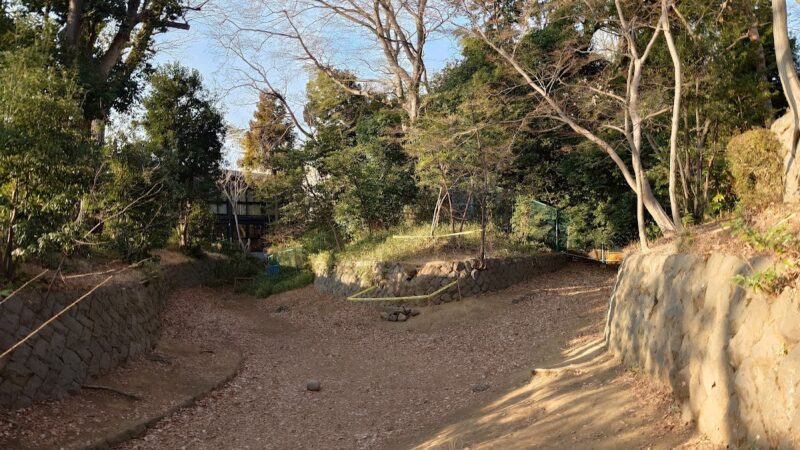
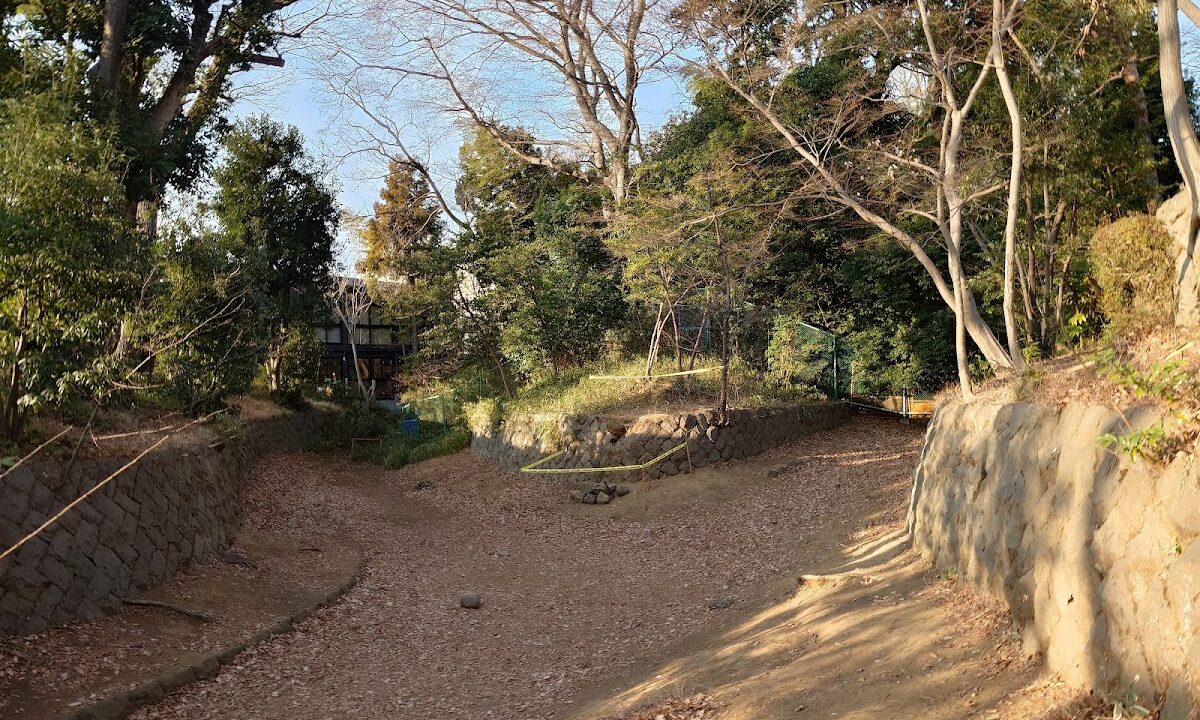
Currently, the remains of Setagaya Castle are maintained and preserved as Setagaya Castle Ruins Park. Within the park, parts of the earthen ramparts and dry moats from the time of construction remain in good condition, conveying the appearance of a medieval castle.
The earthen ramparts in the park are approximately 3-4 meters high and about 10 meters wide at the base, allowing visitors to appreciate the scale of the defensive facilities at the time. The top of the earthen rampart is flat, suggesting that a fence or wall was once erected there.
The dry moat is approximately 3-5 meters deep and 8-10 meters wide, and a walking path has now been constructed at its bottom. Walking along the bottom of the moat offers a valuable opportunity to experience the defensive structure of the time.
Remains around Gotokuji Temple
Remains of Setagaya Castle also exist within the grounds of Gotokuji Temple, adjacent to the west side of Setagaya Castle Ruins Park. Gotokuji Temple was established during the Edo period as the family temple of the Ii family, the lords of the Hikone Domain, and its grounds are believed to be the site of the main keep of Setagaya Castle.
Slight traces of the earthen rampart can be seen near the temple gate and in parts of the grounds. Furthermore, the topography of the temple grounds shows remnants of the castle era, allowing one to imagine what it looked like in its heyday.
Value as a Tokyo Metropolitan Government-Designated Historic Site
Setagaya Castle Ruins were designated as a Tokyo Metropolitan Government Historic Site (equivalent to a Historic Site under the current designated cultural property system) in 1919 (Taisho 8). Recognized for its high historical value as a valuable example of a well-preserved medieval castle site within the urbanized 23 wards of Tokyo.
Currently, the site is preserved and managed by the Setagaya Ward Board of Education, with regular maintenance and grass cutting being carried out. Information boards and explanatory signs are also installed, creating an environment where visitors can learn about history.
Guide to Visiting Setagaya Castle Ruins Park
Basic Information and Access
Location
2-14 Gotokuji, Setagaya-ku, Tokyo
Opening Hours
Open at all times (free entry as it is a park)
Admission Fee
Free
Access by Train
- Approximately 5 minutes on foot from Miyanosaka Station on the Tokyu Setagaya Line
- Approximately 10 minutes on foot from Gotokuji Station on the Odakyu Line
Access by Bus
- Approximately 3 minutes on foot from the Gotokuji bus stop (Odakyu Bus/Tokyu Bus)
Access by Car
Approximately 10 minutes from the Sangenjaya Exit of the Shuto Expressway Route 3 Shibuya Line
*There is no dedicated parking lot, so please use nearby coin parking.
Estimated Visiting Time and Notes
The estimated visiting time for Setagaya Castle Ruins Park is approximately 30 minutes to 1 hour if you take your time to look around. You can take your time observing the earthworks and dry moats, and learn about history while reading the explanatory signs.
Notes for Visitors
- Consideration for Residential Areas: The area around the park is a quiet residential area. Please be considerate and avoid making noise or trespassing on private property.
- Photography: You are free to photograph the ruins, but please be careful not to include surrounding houses in your photos.
- Protection of Ruins: Please do not climb on the earthworks or damage the slopes of the moats.
- Season and Clothing: In summer, take precautions against insects, and be careful as the ground can be slippery in rainy weather.
Nearby Attractions and Spots
Gotokuji Temple: The Temple Where the Maneki-neko (beckoning cat) Originated
Gotokuji Temple, located a 1-minute walk from Setagaya Castle Ruins Park, is a famous temple known as the birthplace of the Maneki-neko. During the Edo period, a legend tells of Ii Naotaka, the lord of the Hikone domain, being guided by a cat to escape a thunderstorm, which is said to be the origin of the Maneki-neko (beckoning cat).
Within the temple grounds is the “Maneki-neko Hall,” where thousands of Maneki-neko figurines are dedicated, creating a breathtaking sight. The temple also boasts a magnificent burial ground as the Ii family’s ancestral temple, including the tomb of Ii Naosuke, a powerful figure during the late Edo period.
Basic Information on Gotokuji Temple
- Visiting Hours: 6:00 AM – 6:00 PM (March – October), 6:00 AM – 5:00 PM (November – February)
- Admission Fee: Free (Free entry to the grounds)
- Access: 1-minute walk from Setagaya Castle Ruins Park
Setagaya City Local History Museum
For those who wish to see detailed information about Setagaya Castle and the Kira clan, a visit to the Setagaya City Local History Museum is recommended. The museum offers a systematic exploration of Setagaya’s history, including exhibits of excavated artifacts, historical documents, and reconstructed models related to Setagaya Castle.
Basic Information on the Local History Museum
- Location: 1-29-18 Setagaya, Setagaya-ku
- Opening Hours: 9:00 AM – 5:00 PM
- Closed: Mondays (or the following day if Monday is a public holiday), New Year holidays
- Admission: Free
- Access: 5-minute walk from Kamimachi Station on the Setagaya Line
Shoin Shrine and Shoin Shrine Street Shopping Arcade
A short walk from Setagaya Castle will take you to Shoin Shrine, dedicated to Yoshida Shoin, a thinker of the late Edo period. The shrine grounds also feature a reconstructed building of the Shoka Sonjuku school, allowing visitors to experience the history of the late Edo period and the Meiji Restoration.
The shopping arcade in front of Shoin Shrine, known as “Shoin Shrine Street Shopping Arcade,” is bustling with stylish cafes, general stores, and restaurants. It’s perfect for a break or lunch after visiting Setagaya Castle.
Basic Information about Shoin Shrine
- Location: 4-35-1 Wakabayashi, Setagaya-ku
- Visiting Hours: Always open
- Access: Immediately after alighting at Shoin-jinja-mae Station on the Setagaya Line; approximately 15 minutes on foot from Setagaya Castle
Exploring the Setagaya Line
The Tokyu Setagaya Line, used to access Setagaya Castle, is a streetcar line connecting Sangenjaya to Shimotakaido. The scenery of retro trains running along the line is a Setagaya specialty, and unique cafes and general stores are scattered along the line.
We recommend taking a stroll along the Setagaya Line in conjunction with visiting Setagaya Castle. Each station has its own unique characteristics, such as the Boroichi Street around Kamimachi Station, the shopping street in front of Shoin Shrine, and the bustling downtown area of Sangenjaya.
Model Itinerary for Visiting Setagaya Castle
Half-Day Course: Visiting Setagaya Castle and Gotokuji Temple
Duration: Approximately 2-3 hours
- Arrive at Miyanosaka Station (10:00)
- Visit Setagaya Castle Ruins Park (10:05-10:45)
Observe the earthworks and dry moats carefully, and learn about the history from the explanatory signs.
- Visit Gotokuji Temple (10:50-11:40)
Visit the Maneki-neko (beckoning cat) hall and the Ii family mausoleum.
- Take a break at a nearby cafe (11:45-12:30)
- Travel to Sangenjaya via the Setagaya Line (12:40)
This course is a compact plan focusing on Setagaya Castle and Gotokuji Temple. Visiting in the morning allows you to enjoy shopping in Sangenjaya or Shibuya in the afternoon.
One-Day Course: Enjoy the History and Culture of Setagaya
Duration: Approximately 6-7 hours
- Arrive at Gotokuji Station (9:30)
- Visit Setagaya Castle Ruins Park (9:40-10:30)
- Visit Gotokuji Temple (10:35-11:30)
- Setagaya City Local History Museum (12:00-13:00)
Transfer to Setagaya Line “Kamimachi Station” for the visit
- Lunch at Boroichi Street (13:10-14:10)
- Visit Shoin Shrine (14:30-15:15)
Transfer to Setagaya Line “Shoin-jinja-mae Station”
- Stroll through Shoin-jinja-dori Shopping Street (15:20-16:30)
- Dinner and Shopping in Sangenjaya (17:00~)
This course is a comprehensive tour of historical sites in Setagaya. Utilizing the Setagaya Line, you can travel efficiently and enjoy both the history and modern charm of Setagaya.
Research and Future Development of Setagaya Castle
Results of Archaeological Excavations
Several archaeological excavations have been conducted at the Setagaya Castle site. These excavations have unearthed medieval pottery fragments, roof tiles, and iron artifacts, shedding light on the lifestyle during the Kira clan’s time.
Of particular note is the large number of artifacts from the late 16th century, providing clues to the castle’s appearance during the Kira clan’s peak. Furthermore, foundation stones and postholes have been confirmed, and research into the reconstruction of the building layout is underway.
Efforts for Preservation and Utilization
The Setagaya Ward Board of Education is focusing on the preservation and utilization of the Setagaya Castle site. Regular mowing and tree management maintain the preservation of the ruins and improve the viewing environment.
In recent years, the explanatory signs have been renewed and guide pamphlets have been created, making it easier for visitors to understand the history. It is also used as a site for local history lessons at local elementary schools, playing a role in passing on history to the next generation.
New Initiatives Utilizing Digital Technology
In the future, the provision of restored images using AR (Augmented Reality) technology is being considered. By holding up a smartphone, the former appearance of Setagaya Castle will appear on the screen, creating an environment where history can be experienced more easily.
The Historical Romance Surrounding Setagaya Castle
The Relationship Between Kira Kōzuke-no-suke and the Setagaya Kira Clan
Kira Kōzuke-no-suke Yoshihisa, known from the story of the Forty-Seven Ronin, was from the Mikawa Kira clan. While related to the Oshu Kira clan of Setagaya, their lineage was different. While both families shared the commonality of being branches of the Ashikaga clan, they developed in different regions.
The Setagaya Kira clan established their power in the Kanto region, while the Mikawa Kira clan maintained their influence in the Tokai region. In the Edo period, the Mikawa Kira clan survived as a prestigious family responsible for the shogunate’s ceremonies, but the Setagaya Kira clan disappeared from the historical stage during Toyotomi Hideyoshi’s siege of Odawara.
Life and Culture of Medieval Samurai
Setagaya Castle, also known as “Gosho” (Imperial Palace), was not merely a military facility but also a cultural center. The Kira clan was enthusiastic about cultural activities such as waka poetry and tea ceremony, and is thought to have played a role in transmitting Kyoto’s aristocratic culture to the Kanto region.
Excavations have unearthed high-quality ceramics and Chinese celadon, suggesting that the Kira clan was economically prosperous and led a cultured life. While medieval samurai are often associated with warfare, life at Setagaya Castle may have been surprisingly cultured.
The End of the Sengoku Period and the Transition to the Edo Period
The abandonment of Setagaya Castle symbolizes a major turning point in history: the end of the Sengoku period and the beginning of the Edo period. Toyotomi Hideyoshi’s unification of Japan and Tokugawa Ieyasu’s establishment of Edo (present-day Tokyo) drastically altered the political landscape of the Kanto region.
Setagaya developed as an agricultural area near Edo and became part of the territory of the Ii family of the Hikone Domain. The Ii family’s development of Gotokuji Temple as their family temple transformed the site of Setagaya Castle into a new historical stage.
Summary: Memories of the Middle Ages Remaining in the City
Setagaya Castle, despite being located in the highly urbanized area of Tokyo’s 23 wards, is a valuable historical site that preserves the remains of a medieval castle. The remains, such as earthworks and dry moats, serve as living teaching materials, conveying the history of approximately 600 years ago to the present day.
Setagaya Castle, with its 230-year history as the residence of eight generations of the Kira clan, its abandonment during the Siege of Odawara in 1590, and modern efforts for its preservation and utilization, embodies a significant part of Japanese history.
Its convenient location, just a 5-minute walk from Miyanosaka Station on the Tokyu Setagaya Line, is another attractive feature. Visiting it along with nearby tourist spots such as the beckoning cats of Gotokuji Temple and Shoin Shrine will allow you to gain a deeper understanding of Setagaya’s history and culture.
Why not visit the ruins of Setagaya Castle, nestled in a quiet residential area, and reflect on the once-prestigious residence known as “Kira Gosho”? Here, you can escape the hustle and bustle of the city and experience a precious moment of medieval history and romance.
A visit to Setagaya Castle is more than just a historical site tour; it offers an opportunity to consider Japanese medieval history, the end of the Sengoku period, and the modern theme of cultural property preservation in the midst of urbanization. Please visit this historic place at least once.