Ajiro Castle (Akiruno City, Tokyo) Complete Guide | History, Remains, Access, and Highlights Explained in Detail
What is Ajiro Castle?
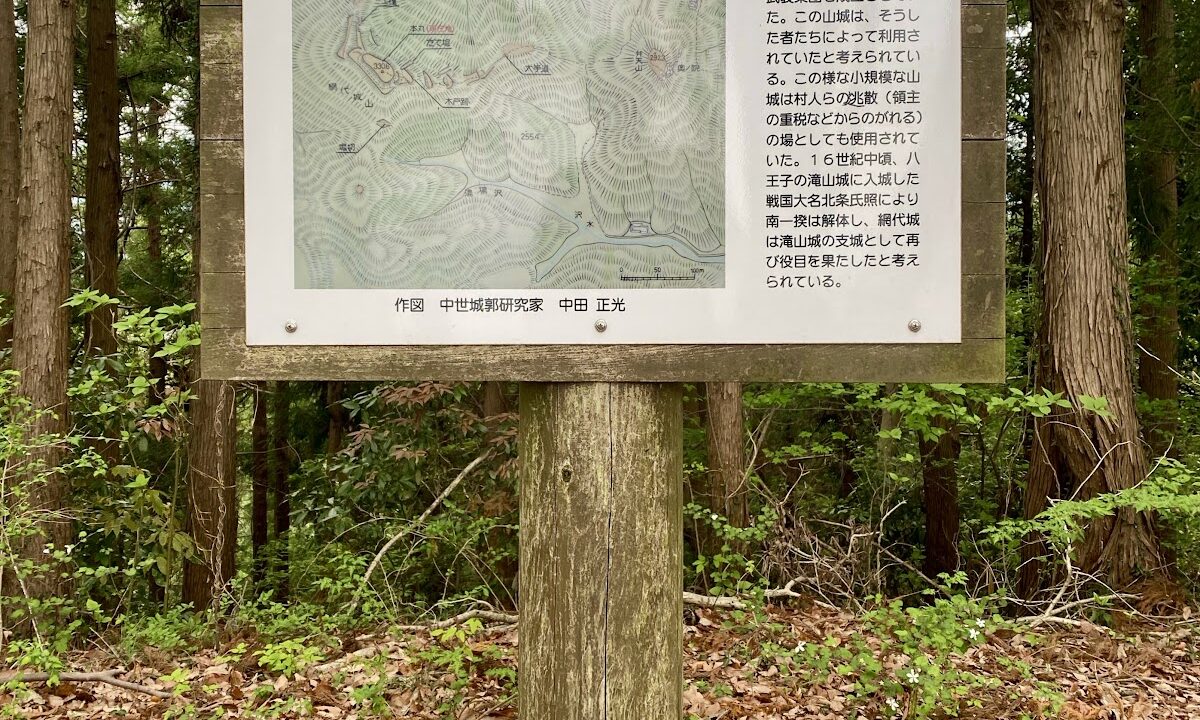
Ajiro Castle is a Sengoku period mountain castle located in Ajiro, Akiruno City, Tokyo. Situated on a hillside along the Akigawa River, it was built around the summit of Shiroyama Mountain, approximately 331 meters above sea level. It is presumed that Hojo Ujiteru built it as a communication network connecting Tokura Castle and Takatsuki Castle, specifically as a beacon tower. However, historical records regarding the detailed construction process are scarce, and much of the castle remains shrouded in mystery.
Currently, it is maintained as Ajiro Bentenyama Park, where remains such as moats and earthworks can be seen in good condition. Shiroyama Mountain is adjacent to Bentenyama Mountain across a saddle in the ridgeline, and presents a semi-independent hill-like topography, connected to the surrounding hills by a single southern spur ridge. Located on the north side, Ajiro Castle boasts an excellent vantage point overlooking the Itsukaichi plain across the Akigawa River, suggesting its importance as a military stronghold.
History of Ajiro Castle
Background and Period of Construction
While there are no definitive historical records regarding the construction date of Ajiro Castle, it is believed to have been built sometime between the mid-15th and 16th centuries during the Sengoku period. During this period, in western Musashi Province, local samurai (warriors) in agricultural and mountain villages held independent power at the village level, acting as leaders of the villagers. Ajiro Castle may have been built as a base for such regional control.
As the Hojo clan expanded its power into the Kanto region, Ajiro Castle gained strategic importance. In particular, when Hojo Ujiteru brought the Tama region under his control from Hachioji Castle and Takiyama Castle, Ajiro Castle is presumed to have functioned as part of a network of beacon towers, coordinating with castles such as Tokura Castle, Takatsuki Castle, and Tobuki Castle.
About the Castle Lord
There are several theories regarding the lord of Ajiro Castle. The “Shinpen Musashi no Kuni Fudoki-ko” (New Compilation of the Topography of Musashi Province) states that Aoki Naiki was the lord. On the other hand, the “Musashi Meisho Zue” (Illustrated Guide to Famous Places in Musashi Province) describes the Kishi clan as the lords. The Kishi clan is said to have been connected to the Kishijima Shrine located at the foot of the castle, suggesting they were likely influential figures in the region.
Furthermore, there is a theory that the Aoki clan were the builders, suggesting they were local samurai who held power in this region during the Sengoku period. In any case, Ajiro Castle is thought to have been a mountain castle ruled by a small local lord, positioned at the lower end of the Hojo clan’s control system.
Connection to the Minami Ikki (Southern Uprising)
The area around Ajiro Castle was also the stage for a regional resistance movement known as the “Minami Ikki” (Southern Uprising), which occurred during the Sengoku period. The Minami Ikki is known as resistance by local forces against the Hojo clan’s rule, and Ajiro Castle is thought to have been involved in this movement. Nearby Kōtokuji Urayama Castle is also listed as one of the strongholds related to the Southern Rebellion, illustrating the complex political situation in this region.
Abandoned Castle and Present Day
There are no clear records of when Ajiro Castle was abandoned, but it is presumed to have been abandoned along with many of its subsidiary castles after the fall of the Hōjō clan in Toyotomi Hideyoshi’s Odawara campaign in 1590. Afterward, the castle site was left as a forest for a long time, but in recent years, the importance of the remains has been recognized, and it has been developed into Ajiro Bentenyama Park.
Structure and Remains of Ajiro Castle
Characteristics of the Layout
Ajiro Castle has a typical mountain castle structure, with the main enclosure (honmaru) at the summit of the castle mountain, surrounded by multiple baileys (kuruwa). The castle area is approximately 200 meters north-south and 150 meters east-west, making it a relatively compact layout.
The castle’s most distinctive feature is that it is a mountain castle that retains an old style. No later modifications such as stone walls are visible; the castle primarily consists of earthworks and moats. This suggests that the castle was built relatively early.
Main Enclosure (Honmaru)
Located on the mountaintop, the main enclosure is a flat area approximately 30 meters east-west and 20 meters north-south. Traces of earthworks can be seen around the perimeter, suggesting that fences or walls once surrounded it. From the main enclosure, one can see the plains of the Akigawa River basin to the north and the Okutama Mountains to the south, offering excellent views.
The elevation of the main enclosure is approximately 331 meters, with a relative height of about 100 meters from the foot of the mountain. This relative height is sufficient for defense, making it a location that could effectively defend against enemy attacks.
Moat
The most prominent remains of Ajiro Castle are the moats. Clear moats can be seen on the south and north sides of the main enclosure. The southern moat, in particular, is approximately 5 meters deep and 10 meters wide, completely blocking the ridge. This moat was an important defensive structure designed to prevent enemy intrusion and is a valuable historical site for understanding the castle construction techniques of the time.
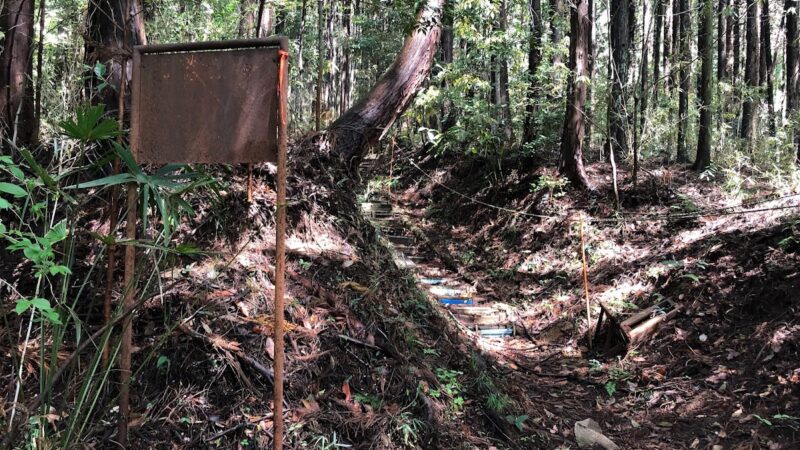
The bottom of the moat still retains its V-shaped cross-section, preserving much of its original form. Visitors can actually cross this moat while walking the approach to the castle, experiencing the defensive structure of a medieval mountain castle firsthand.
Enclosures
Several enclosures are arranged around the main enclosure. Flat, belt-like areas can be seen on the east and west sides of the main enclosure; these are thought to have been defensive structures. Furthermore, a series of terraced enclosures line the southern ridge, serving to limit enemy intrusion routes.
These enclosures, though not as large as the main enclosure, are presumed to have been used for troop garrisons or storage of supplies. Even today, the elevation changes and flat areas of the baileys can be observed, providing clues to understanding the overall structure of the castle.
Earthworks
Traces of earthworks remain along the edges of the main bailey and each bailey. These earthworks were defensive structures designed to protect against enemy arrows and stones, with soldiers hiding inside them during battle. The earthworks of Ajiro Castle are about 1-2 meters high, making them medium-sized, but standard for a mountain castle.
While some of the earthworks have been lost due to collapse and weathering, they remain in relatively good condition in areas such as the northeastern part of the main bailey, allowing us to trace the original defensive lines.
Highlights of Ajiro Castle
View from the Main Bailey
The greatest highlight of Ajiro Castle is the view from the main bailey. To the north lies the plains of the Akigawa River basin, offering a panoramic view of the town of Itsukaichi. On clear days, you can even see as far as the Kanto Plain. Furthermore, the Okutama Mountains stretch out to the south, offering beautiful scenery throughout the seasons.
This view is not only beautiful, but also important for understanding its function as a beacon tower. It reveals the possibility of visual communication with surrounding castles such as Tokura Castle and Takatsuki Castle, giving a real sense of the communication network of the Sengoku period.
The Impressive Moat
As mentioned earlier, the moats of Ajiro Castle are remarkably clear, making them an excellent resource for learning about the defensive structures of medieval mountain castles. The large moat on the south side, in particular, is a popular attraction for castle enthusiasts due to its scale and excellent state of preservation.
Looking up from the bottom of the moat, the steep cliffs on both sides loom imposingly, creating a powerful sense of scale. Looking back after crossing the moat, the structure that completely blocks the ridge becomes clear, allowing one to understand the intentions of the castle’s builder.
Kishijima Shrine
Kishijima Shrine, located at the main entrance (Ote-guchi) of Ajiro Castle, is another point of interest. This shrine is said to have connections to the Kishi clan, who are believed to have been the castle’s lords, making it an important place to consider when thinking about the castle’s history. The shrine grounds are well-maintained, and the path to the castle begins here.
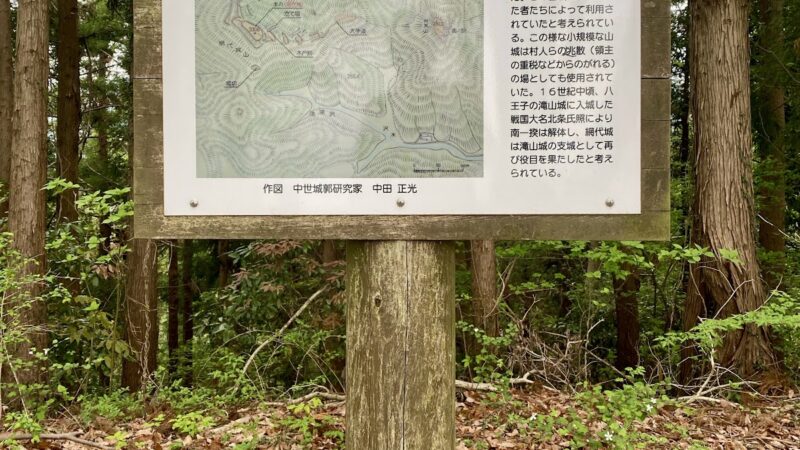
The shrine also has an information board for “Ajiro Castle Ruins,” where you can learn about the castle’s overview. It’s a good idea to pay your respects before climbing the castle and reflect on its history.
Takao Shrine Route
Besides the route from Kishijima Shrine, there is also a route from Takao Shrine (the rear entrance) to Ajiro Castle. This route is considered more suitable for experienced climbers due to its steep slopes and significant ups and downs, but it offers a more varied climbing experience.
The Takao Shrine route involves climbing the western slope of the castle, allowing you to observe different remains and terrain than those on the Kishijima Shrine route. If you have the time and energy, it is recommended to hike both routes to get a complete picture of the castle.
Traverse with Bentenyama
Ajiro Castle Mountain is connected to Bentenyama Mountain by a ridge, and a hiking course traversing both mountains is also popular. From Bentenyama, you can view the Akigawa River basin from a different angle than from Ajiro Castle, allowing for a deeper understanding of the region’s topographical features.
The traverse course takes approximately 2-3 hours in total, offering a moderate amount of exercise and enjoyable scenery changes, making it ideal for those who want to combine castle exploration with hiking.
Access Methods
Access by Train
When visiting Ajiro Castle by train, the nearest stations are Musashi-Itsukaichi Station or Musashi-Masudo Station on the JR Itsukaichi Line.
From Musashi-Itsukaichi Station
- Approximately 30 minutes on foot from the station (approx. 2.5 km)
- Take a Nishi-Tokyo Bus from the station and get off at the “Ajiro” bus stop, then approximately 10 minutes on foot.
From Musashi-Masudo Station
- Approximately 25 minutes on foot from the station (approx. 2 km)
- This route is closer to the castle.
From either station, the easiest route is to walk towards Kishijima Shrine. There are signposts along the way, so you are unlikely to get lost.
Access by Car and Parking
If you are visiting by car, the nearest interchanges on the Chuo Expressway are Hachioji IC or Akiruno IC.
From Hachioji IC:
- Approximately 30 minutes via National Route 411 (Takiyama Kaido)
From Akiruno IC:
- Approximately 20 minutes via National Route 411
Regarding parking, you may be able to use the parking lot at Ajiro Kaikan (prior confirmation is recommended). There are also a few parking spaces near Kishijima Shrine, but the number is limited, so consider using public transportation.
Access Route and Estimated Time
Kishijima Shrine Route (Ote-guchi)
This is the most common access route.
- Kishijima Shrine (Elevation approx. 230m)
- Check information on the castle ruins information board
- Take the mountain path from the castle entrance
- Castle Ascent Route (approx. 15 minutes)
- Well-maintained stairs and mountain path
- Relatively gentle slope
- Moat (approx. 20 minutes)
- Pass the large moat on the south side
- Observation point for the remains
- Arrival at the Main Enclosure (approx. 25 minutes)
- Arrive at the main enclosure at the mountaintop
- Enjoy the view
The standard round trip takes approximately 1 to 1.5 hours. Allow about 2 hours if you want to carefully observe the remains.
Takao Shrine Route (Rear Gate)
A more challenging route.
- Takao Shrine (Elevation approx. 250m)
- Approach from the west
- Steep Ascent Section (approx. 20 minutes)
- Stairs and steep slopes
- Significant ups and downs
- Western Enclosure Group (approx. 30 minutes)
- Observe the remains on the west side
- Arrival at the Main Enclosure (approx. 40 minutes)
- Arrive at the main enclosure
The Takao Shrine route takes longer and requires more stamina than the Kishijima Shrine route. Allow 1 hour 30 minutes to 2 hours round trip.
Benten-yama Traverse Route
This course combines Ajiro Castle Mountain and Benten-yama.
- From Kishijima Shrine to Ajiro Castle Mountain (approx. 25 minutes)
- Descend from Ajiro Castle Mountain to the saddle (approx. 10 minutes)
- Climb from the saddle to Benten Mountain (approx. 15 minutes)
- Descend from Benten Mountain (approx. 20 minutes)
This is a 2-3 hour hiking course in total. It’s a popular route where you can enjoy the nature of the Akigawa Hills while exploring the castle.
Notes for Visitors
Clothing and Equipment
Since Ajiro Castle is a mountain castle, the following equipment is recommended.
- Footwear: Trekking shoes or athletic shoes (sneakers acceptable)
- Clothing: Comfortable clothing, long sleeves and long pants recommended (for bushwhacking)
- Items to bring: Drinking water, towel, rain gear, insect repellent (summer)
- Other: Map, camera, binoculars (for viewing the scenery)
Differences by Season
Spring (March-May)
- Beautiful fresh greenery, moderate temperature, ideal for climbing the castle
- Enjoy the scenery at the foot of the mountain during cherry blossom season
Summer (June-August)
- Hot and humid, many insects, so caution is necessary
- Early morning visit is recommended
- Take thorough precautions against heatstroke
Autumn (September-November)
- Beautiful autumn foliage, the most popular season
- Comfortable temperature, ideal for climbing the castle
- Excellent views
Winter (December-February)
- Clear air, best views
- Fallen leaves make the ruins easier to observe.
- Be careful of freezing temperatures and snow (though this is rare).
Safety Management
- Avoid climbing alone; visiting with multiple people is recommended.
- Refrain from climbing in bad weather (rain, strong winds).
- A climbing plan is not required, but inform family members of your destination.
- Cell phone reception is generally available at the summit, but check just in case.
- Be sure to descend before sunset (no lighting facilities).
Nearby Castles and Tourist Spots
Nearby Castles
Numerous castles important for understanding the Hojo clan’s rule exist around Ajiro Castle.
Tokura Castle (approx. 2km east)
- Mountain castle along the Akigawa River
- Connected to Ajiro Castle via a signal fire network
- Relative elevation approximately 120m, well-preserved remains
Takatsuki Castle (approx. 5km northeast)
- One of Hojo Ujiteru’s branch castles
- Communication base with Ajiro Castle
- Remains of moats and earthworks
Hachioji Castle (approx. 15km northeast)
- Main castle of Hojo Ujiteru
- National Historic Site
- Large-scale mountain castle remains
Takiyama Castle (approx. 18km northeast)
- Former main castle of Hojo Ujiteru
- Developed as a metropolitan park
- One of the leading medieval castles in the Kanto region
Tobuki Castle (approx. 8km north)
- Mountain castle in Akiruno City
- Base of a local powerful family
Jofukuji Castle (approx. 6km southeast)
- Castle utilizing a temple
- Unique Territories
Odano Castle (approx. 7km south)
- Base in the Okutama area
- Deep mountain location
Ninomiya Castle (approx. 10km east)
- Castle along the Tama River
- Straightforward transportation hub
Katsunuma Castle (approx. 12km west)
- Castle in the Okutama region
- Connection to mountain worship
Hinohara Castle (approx. 15km west)
- Castle in the deepest part of Okutama
- Base of the Hirayama clan
By visiting these castles, you can gain a three-dimensional understanding of the Hojo clan’s control structure in the Tama region during the Sengoku period.
Nearby Temples, Shrines, and Historical Sites
Kōtoku-ji Temple (approx. 3km)
- A temple related to the Southern Rebellion
- Remains of Urayama Castle
- A building designated as an Important Cultural Property
Hachiman Shrine (approx. 2km)
- Local guardian shrine
- Conveys medieval beliefs
Akigawa Valley (approx. 5km)
- Beautiful natural scenery
- Popular for hiking and camping
Tourist Facilities
Akiruno City Local History Museum (approx. 3km)
- Learn about local history
- Also features medieval exhibits
Itsukaichi Local History Museum (approx. 2.5km)
- History and culture of Itsukaichi
- Free admission
Akigawa Farmers Center (approx. 3km)
- Direct sales of local agricultural products
- Fresh vegetables and fruits
The Charm and Historical Value of Ajiro Castle
A Part of the Beacon Network
The greatest historical value of Ajiro Castle lies in its presumed function as part of the Hojo clan’s beacon network. During the Sengoku period, information transmission was a crucial factor in determining the success or failure of military operations. Beacon fires (noroshi) were a means of communication using smoke and fire to transmit information over long distances, with smoke used during the day and fire at night.
Ajiro Castle is located midway between Tokura Castle and Takatsuki Castle, visually connecting the two. This location is likely not accidental but rather a deliberate strategic placement. Indeed, looking around from the main enclosure reveals points where the locations of several mountain castles can be estimated, demonstrating its function as a beacon station.
A Hub for Regional Control
Ajiro Castle was important not only as a beacon station but also as a hub for regional control. The Akigawa River basin had agricultural productivity and was also a transportation route to the Okutama area. Securing control of this region was essential for maintaining the Hojo clan’s power.
The Aoki and Kishi clans, believed to be the castle lords, are thought to have been influential local figures who led the farmers, responsible for collecting taxes and mobilizing troops for military service. Ajiro Castle was a symbolic representation of this regional control and a facility demonstrating the authority of the lords.
Ancient Mountain Castle Structure
The remains of Ajiro Castle retain many characteristics of mountain castles from the early to mid-Sengoku period. Its earthwork structure without stone walls, relatively simple layout, and defensive lines skillfully utilizing natural terrain make it a typical example of an older style of mountain castle.
These characteristics provide valuable information for understanding the development of castle construction techniques. By comparing it with castles from later periods, we can understand the changes in castle construction techniques during the Sengoku period.
Excellent State of Preservation
The remains of Ajiro Castle are relatively well-preserved, having escaped the waves of development. The moats, in particular, are clearly visible and convey the appearance of the castle at the time of its construction. Such well-preserved remains are a valuable learning opportunity not only for researchers but also for general castle enthusiasts. In recent years, the area has been developed into Ajiro Bentenyama Park, improving access and attracting more visitors. However, excessive development could damage the historical remains, so balancing preservation and utilization will be a challenge going forward.
Current Status and Challenges of Ajiro Castle Research
Lack of Historical Materials
The biggest challenge regarding Ajiro Castle is the lack of historical materials. Even basic information such as the builder, construction date, lord, and abandonment period lacks definitive historical records, forcing us to rely on estimations. While there are descriptions in Edo period geographical records such as the “Shinpen Musashi no Kuni Fudoki-ko” and “Musashi Meisho Zue,” these are compilations of traditions and cannot be considered primary sources.
It is hoped that new historical materials will be discovered in the future through ancient documents and archaeological excavations. In particular, there is a possibility that descriptions of Ajiro Castle may be found in documents remaining in surrounding temples, shrines, and old families.
The Need for Archaeological Excavations
Very little full-scale archaeological excavation has been conducted at Ajiro Castle. Detailed surveys and trial excavations of the remains could potentially provide a more accurate understanding of the castle’s structure and period of use.
In particular, excavations of the main enclosure and baileys, if they uncover building remains or artifacts, would significantly contribute to understanding the castle’s true nature. Furthermore, cross-sectional surveys of the moats could reveal details of the castle’s construction techniques.
Relationship with Surrounding Castles
It is important not only to study Ajiro Castle in isolation, but also to comprehensively study its relationship with surrounding castles. Clarifying its positional relationship with castles that existed during the same period, such as Tokura Castle, Takatsuki Castle, and Tobuki Castle, as well as the commonalities and differences in construction techniques and the actual state of the beacon network, will reveal a complete picture of the Hojo clan’s regional control.
Such research requires collaboration among multiple local governments and research institutions, which remains a challenge for the future.
Summary
Ajiro Castle is a valuable Sengoku period mountain castle remaining in Akiruno City, Tokyo. It is presumed to have played a part in the Hojo clan’s beacon network and functioned as a base for regional control. The remains of the castle, such as moats and earthworks, are well-preserved, making it an excellent resource for learning about the structure of medieval mountain castles.
The view from the main enclosure is magnificent, offering panoramic views from the plains of the Akigawa River basin to the Okutama Mountains. This view is not only beautiful but also gives a real sense of its function as a beacon tower.
Access is relatively easy, within walking distance from Musashi-Itsukaichi Station and Musashi-Masudo Station on the JR Itsukaichi Line. The climbing route is well-maintained, making it safe even for beginners. The round trip takes about 1-2 hours, making it enjoyable as a casual hike.
Numerous other castles exist in the surrounding area, including Tokura Castle, Takatsuki Castle, Hachioji Castle, and Takiyama Castle. Visiting these castles provides a comprehensive understanding of the history of the Tama region during the Sengoku period. Furthermore, the natural scenery of the Akigawa Valley is beautiful, making it possible to combine castle exploration with sightseeing.
While research challenges remain, such as a lack of historical records and the absence of archaeological excavations, this only heightens expectations for future discoveries. Ajiro Castle is a fascinating fortress that evokes a sense of historical romance, and it’s a place that many people should visit.
Located within Tokyo, Ajiro Castle boasts a harmonious blend of rich nature and historical remains. Why not visit and experience the spirit of the Sengoku period?